
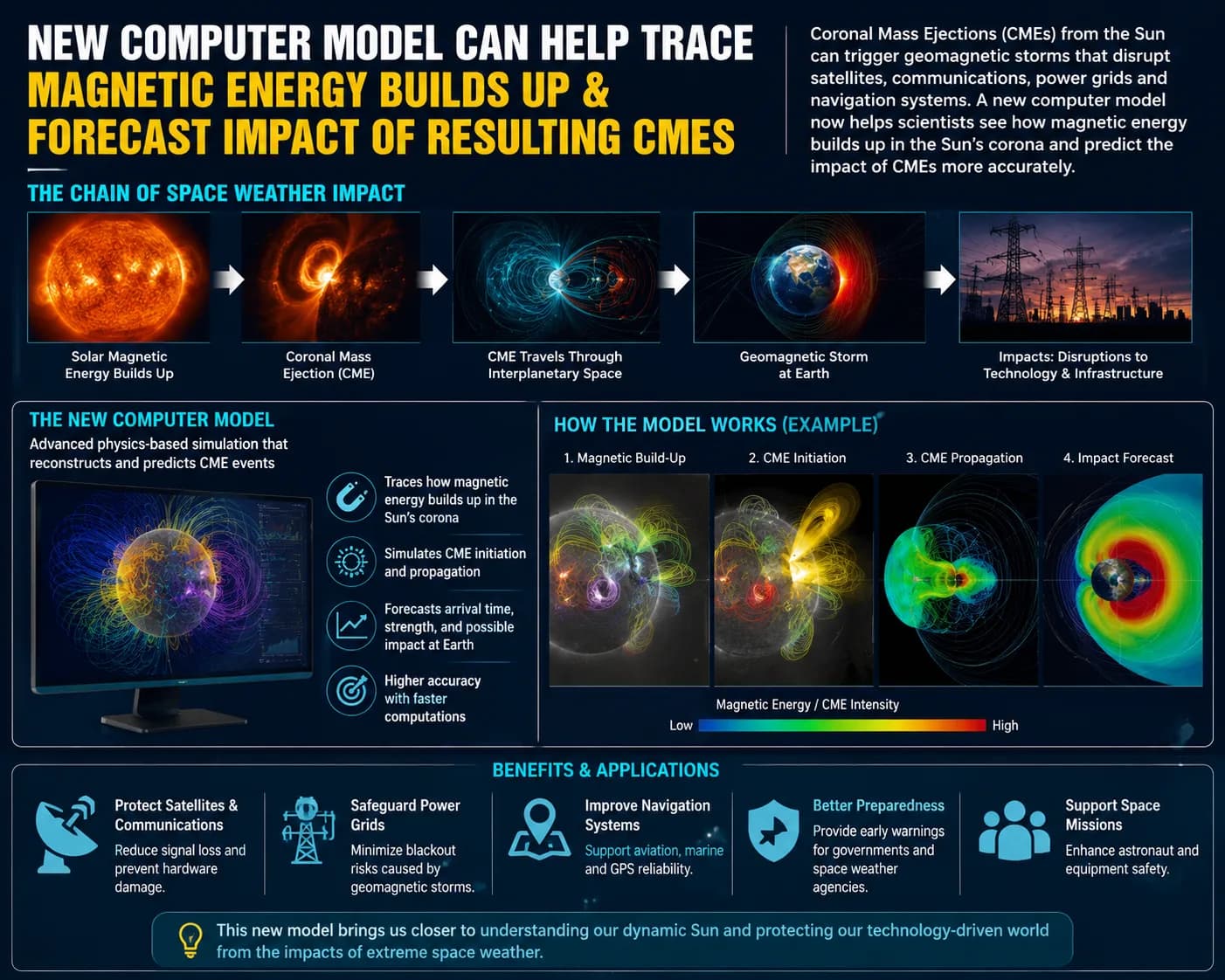
New computer model can help trace magnetic energy builds up & forecast impact of resulting CMEs
A multi-institutional team of scientists have developed a three-dimensional computer simulation model that can bring scientists a step closer to forecasting the arrival and impact of Coronal Mass Ejections (CMEs) before they reach Earth.
CMEs are among the most dramatic and powerful events in our solar system — gigantic eruptions of magnetized plasma hurled from the Sun at millions of kilometres per hour. When directed toward Earth, they can damage satellite systems, disrupt power grids, and interfere with global communications. At the heart of these eruptions lie magnetic flux ropes (MFRs), which are twisted bundles of magnetic field lines embedded in the plasma, and are widely regarded as the primary triggers of CMEs. Yet, how the magnetic energy builds up, and is then released during CMEs has remained one of solar physics' most stubborn mysteries through the violent expulsion has been poorly understood until now. In order to trace the evolution of the magnetic energy to CMEs researchers at the Indian Institute of Astrophysics, an autonomous institute of the Department of Science & Technology (DST), Govt. of India, along with their collaborators, have developed sophisticated three-dimensional magnetohydrodynamic (MHD) computer simulation model.
This model traces, step by step, how the reconnection flux changes as a magnetic flux rope rises, stretches the surrounding ambient magnetic field, and ultimately erupts. The model begins with a realistic coronal setup of a solar atmosphere, which is threaded by a magnetic field configuration resembling a coronal streamer in observation. A twisted magnetic flux rope is gradually introduced into this from below, mimicking how new magnetic flux emerges from beneath the solar surface. The computational work in this study was performed on the NOVA HPC facility. This high-performance computing infrastructure is hosted at the data center of the IIA.
As the flux rope rises, the team observed in their computer models that the overlying magnetic field is significantly stretched and compressed beneath it. Reconnection does not begin explosively. Instead, it starts quietly with the slow formation of a thin sheet of strong electric current, a thin layer where opposing magnetic fields are pushed together. Over time, this process intensifies, culminating in the impulsive, large-scale expulsion of the flux rope.
What makes this study published in Astrophysical Journal particularly compelling is its dual approach. The researchers not only simulated two successive flux rope eruptions in their model, but also cross-validated their findings with another researcher from the University of Helsinki, Finland, who teamed up with the Indian group to contribute analysis based on observational data from NASA's Helioseismic and Magnetic Imager (HMI) and the Atmospheric Imaging Assembly (AIA), two of the most powerful instruments currently observing the Sun. The comparison between simulation and observation revealed a striking result: the rate of magnetic reconnection correlates the acceleration of the CME in a clear, monotonic fashion, meaning that as reconnection speeds up, so does the eruption, from start to finish. This finding establishes reconnection flux as a critical factor in determining not just whether a CME erupts, but how fast and how energetically it does so.
This work by the team comprising Dr. Samriddhi Sankar Maity (Postdoc at NASA & Georgia State University, USA), Dr. Piyali Chatterjee, IIA and Mr. Ijas S Mytheen (PhD student, Eotvos University, Hungary) and Dr. Ranadeep Sarkar from the University of Helsinki, Finland, offers important new insight into the chain of events that transforms a slowly building magnetic structure into one of the powerful explosions in our solar system.
Publication link: https://iopscience.iop.org/article/10.3847/1538-4357/ae3d9a.
For news tips, coverage requests, or media enquiries, email us at airmedianews@gmail.com.